Programming
Build a Calisthenics Leg Workout With No Equipment
Build a calisthenics leg workout with no equipment: split squats, pistol squat progressions, lunges and jump work, with sets, reps and a weekly plan.
A calisthenics leg workout needs single-leg exercises added on top of bodyweight squats, because two legs sharing your bodyweight stop challenging your muscles once your squat gets easy. Single-leg work roughly doubles the load each leg carries with no added weight at all. Research comparing bodyweight leg exercises found the Bulgarian split squat and the backward lunge produced the highest quad activation of 7 exercises tested, ahead of basic squats and step-downs. This guide gives you the exercises worth your time, a weekly plan, and how to keep progressing without a single plate or dumbbell.
Know the 7 best bodyweight leg exercises
| Exercise | Primary muscle | Difficulty |
|---|---|---|
| Bodyweight squat | Quads, glutes | Beginner |
| Split squat | Quads, glutes, balance | Beginner to intermediate |
| Bulgarian split squat | Quads, glutes | Intermediate |
| Backward lunge | Quads, glutes | Intermediate |
| Single-leg glute bridge | Glutes, hamstrings | Beginner to intermediate |
| Pistol squat (full or assisted) | Quads, glutes, balance | Advanced |
| Jump squat | Quads, glutes, power | Intermediate to advanced |
Bulgarian split squat
Rest the top of one foot on a bench or step behind you, lower your back knee toward the floor, and drive back up through your front heel. Keep your front shin close to vertical so your knee does not drift far past your toes. This single exercise carried the highest quad activation of any bodyweight leg exercise in the research above, which makes it worth the balance challenge it demands at first.
Backward lunge
Step one leg back and lower until your back knee nearly touches the floor, then drive forward through your front leg to return to standing. Stepping backward rather than forward loads your front leg similarly to a split squat while feeling more stable for most beginners.
Single-leg glute bridge
Lie on your back, one foot planted and one leg extended straight, and drive your hips up through the planted heel. It is the easiest effective way to load your hamstrings and glutes without any equipment.
Pistol squat
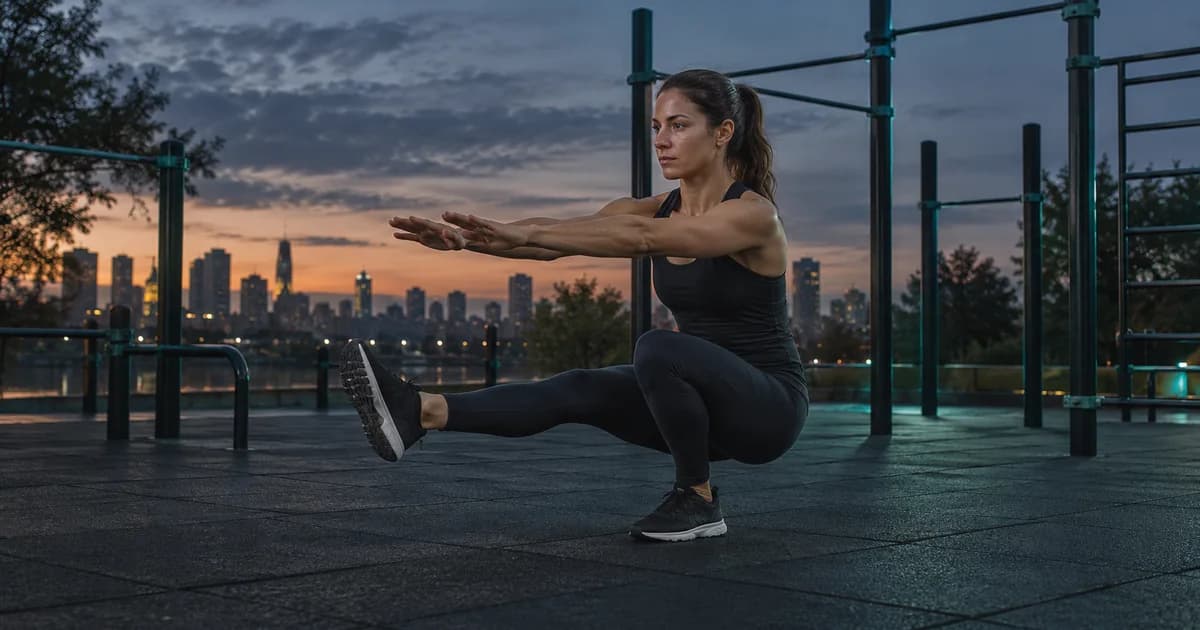
A full pistol squat, lowering on one leg with the other extended forward, demands quad strength, ankle mobility and balance together. Build it in stages rather than forcing it: our pistol squat progression guide covers the full path from an assisted box pistol to a free-standing one.
Jump squat
Squat down and explode upward into a jump, landing softly with bent knees. Use it sparingly and only once your split squats and lunges feel controlled, since the landing asks more of your joints than any of the exercises above.
Program a weekly leg session
Train legs twice a week with at least 48 hours between sessions, and pick one unilateral exercise plus one bilateral or posterior-chain exercise each time.
| Day | Main work | Support work |
|---|---|---|
| Session A | Bulgarian split squat: 4 sets of 8 to 12 per leg | Bodyweight squat: 3 sets of 15 to 20, single-leg glute bridge: 3 sets of 12 to 15 per leg |
| Session B | Backward lunge: 4 sets of 10 to 12 per leg | Pistol squat progression step: 3 sets of 5 to 8 per leg, jump squat: 3 sets of 8 to 10 |
If you are brand new to training altogether, start with the general structure in how to start calisthenics before you add a dedicated leg day on top of it, or slot this plan straight into the calisthenics workout plan for beginners as your lower-body days.
Progress without adding weight
- Slow your tempo. A 3 to 4 second lowering phase on any exercise above adds real difficulty with zero equipment.
- Deepen your range first. Add depth before you add reps. A half-range split squat builds less strength than a full-range one at higher reps.
- Add a pause. A 2-second pause at the bottom of a split squat or lunge removes the stretch reflex that helps you out of a normal rep.
- Narrow your base of support. Move from a split squat to a Bulgarian split squat to a pistol squat as balance stops being the limiting factor.
- Add a backpack once bodyweight stops being enough. Loading a backpack with books is still a no-equipment solution if you train somewhere without plates, and it extends every exercise above for months longer.
Progress at the pace your knees and ankles tolerate. Mobility usually limits a full pistol squat more than strength does, so work on ankle and hip mobility alongside the strength work above rather than forcing depth your joints are not ready for.
Warm up your ankles and hips before you squat deep
- Ankle rocks. Kneel with one foot forward, rock your knee over your toes repeatedly without lifting your heel. Do 10 to 15 per side before squatting.
- Deep squat holds. Drop into the deepest bodyweight squat you can control and hold for 20 to 30 seconds, using a doorframe or pole for balance if you need it.
- Walking lunges with a reach. Step into a lunge and reach both arms overhead to open your hip flexors before you load the same pattern.
- Leg swings. Hold a wall or pole and swing one leg forward and back, then side to side, 10 reps each direction per leg.
Five minutes of this before a leg session makes a real difference to how deep and how controlled your first working set feels, especially on pistol squat and deep lunge work.
Fix these common leg workout mistakes
| Mistake | What happens | Fix |
|---|---|---|
| Letting your front knee cave inward | Your knee joint absorbs stress meant for your hip and glute | Push your knee out in line with your foot on every rep |
| Rushing straight to a free pistol squat | You either fall out of the bottom or cut the range short | Build through assisted and box-supported steps first |
| Only training bilateral squats | Each leg gets half the stimulus a unilateral exercise gives it | Add at least one single-leg exercise to every leg session |
| Skipping the posterior chain | Your quads develop faster than your hamstrings and glutes | Pair a quad-dominant move with a glute bridge or hip hinge every session |
Common questions
Can you build leg muscle with calisthenics alone?
Yes, especially with single-leg exercises like the Bulgarian split squat and pistol squat, which load each leg far harder than a two-legged bodyweight squat. Progress comes from range, tempo and single-leg difficulty rather than added weight.
What is the hardest bodyweight leg exercise?
A full, free-standing pistol squat is the usual benchmark, since it demands quad strength, ankle mobility and balance all at once. Jump variations add power demands but rarely match the pistol squat's strength requirement.
How often should you train legs with calisthenics?
Twice a week, with at least 48 hours between sessions, works well for most people. That gives you enough frequency to progress while leaving time to recover from the balance and joint demands of single-leg work.
Do you need weights eventually for leg growth?
Not necessarily. Single-leg exercises, slower tempos and deeper ranges can keep bodyweight training challenging for a long time. Added load, including a loaded backpack, simply extends that runway further once bodyweight alone stops being enough. See our calisthenics vs weights comparison for how the two approaches stack up for leg development specifically.